

Artist Blog
Every week an artist whose single image was published by Der Greif is given a platform in which to blog about contemporary photography.


Women, Medicine and Photography
Nov 10, 2016 - Milja Laurila
“Take your clothes off”, the doctor said to me, as she was getting her camera ready. She wanted to take pictures of my body for medical purposes. I was left standing naked in front of a white wall as the doctor and her assistant were wondering how the hospital’s new SLR camera works.
When they found the correct settings, she started shooting. The nurse lifted my arms, turned my shoulders and thighs into a better position so the doctor could get a good picture. It was as if I wasn’t there.
This was ten years ago. Could it explain my interest towards medical photography and pictures of patients?
I look for image material for my works in old books and archives. During the years, I have seen hundreds and hundreds of medical pictures, mainly from the 1900s. Why do most of them portray young, naked women?
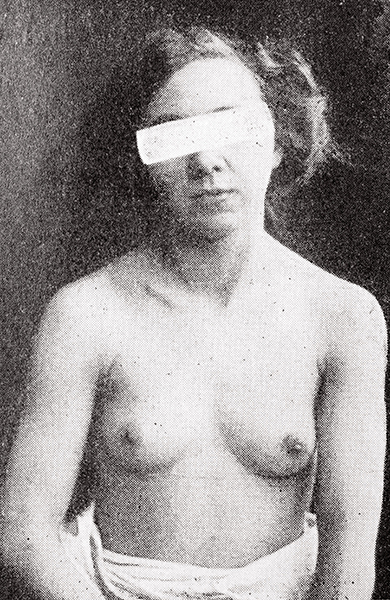
The images often demonstrate a damage or deviation of some kind. However, it is the female patients who are pictured naked even when the damage or deviation would not require it. For example, an injury to the neck is demonstrated in a photograph where the young woman is shown from waist up, with bare breasts and covered eyes. What is the purpose of these photographs?
It’s my guess that at the time, the photographers as well as the doctors must have been older men. This leads me to the act of looking and being looked at. What lies behind the medical image? Whose is the medical gaze? And how are women viewed through the history of medicine?
Åsa Slotte, philosopher conducting research on diagnostics, medicine and ethics at Åbo Akademi in Finland has said in an interview for the Finnish Broadcasting Company, that women and men have been considered in various ways since antiquity. Aristotle believed that the woman was a colder and less complete version of the human, but that her biology and genitals corresponded those of man: they mirrored each other. Some scientists have suggested that a such “single sex model” dominated medical thinking until the 1700s.
In fact, it wasn’t until the 1700s, that women began to be perceived as radically different from men. The woman parted in principle like a different species, a deviation from the male norm. She began to be determined by her gender, that is, of her reproductive functions.
In the late 1800s diagnoses such as hysteria, neurasthenia and chlorosis flourished, and this perception of the weak and frail woman is also seen in medical science at the time.
According to Slotte, there are many scientists today who assume that medicine and psychiatry are patriarchal because women’s life experiences are often medicalized. Diagnoses such as eating disorder or fear of childbirth are examples of this.
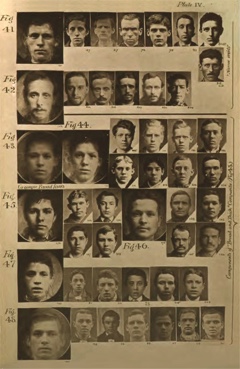
Old medical photographs remind me of how photography was used as a power tool in the late 19th century, in particular in images of criminals and in eugenics, the most famous example being Sir Francis Galton (1822–1911) and his composite photographs.
During Galton’s time, and for years and years after (!), sexually active and unmarried women were seen as a danger to the community and could be labeled as mentally ill or criminal.
In Finland, Amanda, a vagrant and a sexually active young woman wrote in her diary in the late 19th century: “They say that I am insane, but I am merely contemplating”. Amanda was diagnosed with “menstrual insanity”, and was taken to Seili Island, a former leper hospital that was transformed into a secluded institute for the mentally ill. Like most of the patients – or inmates – at Seili, Amanda spent the rest of her life there.
The symptoms, diagnostics and treatment of illnesses reflect the views of their time. What is regarded as “normal” or stated as a scientific fact changes during the course of time. In the early 20th century, the hereditary of mental illness as well as degeneration was a topical issue. It was believed that mental illness manifested itself as physical signs, meaning that it could be seen. Common practice was to describe the appearance of the patients meticulously. And what could be a better way to do this than photography, which had lent itself to the use of science ever since its invention?